Rice is the backbone of food security in Southeast Asia (SEA), feeding millions and supporting livelihoods across the region and worldwide. But our research reveals that climate change is quietly disrupting one of the most critical drivers of rice production in SEA: the rainy season.
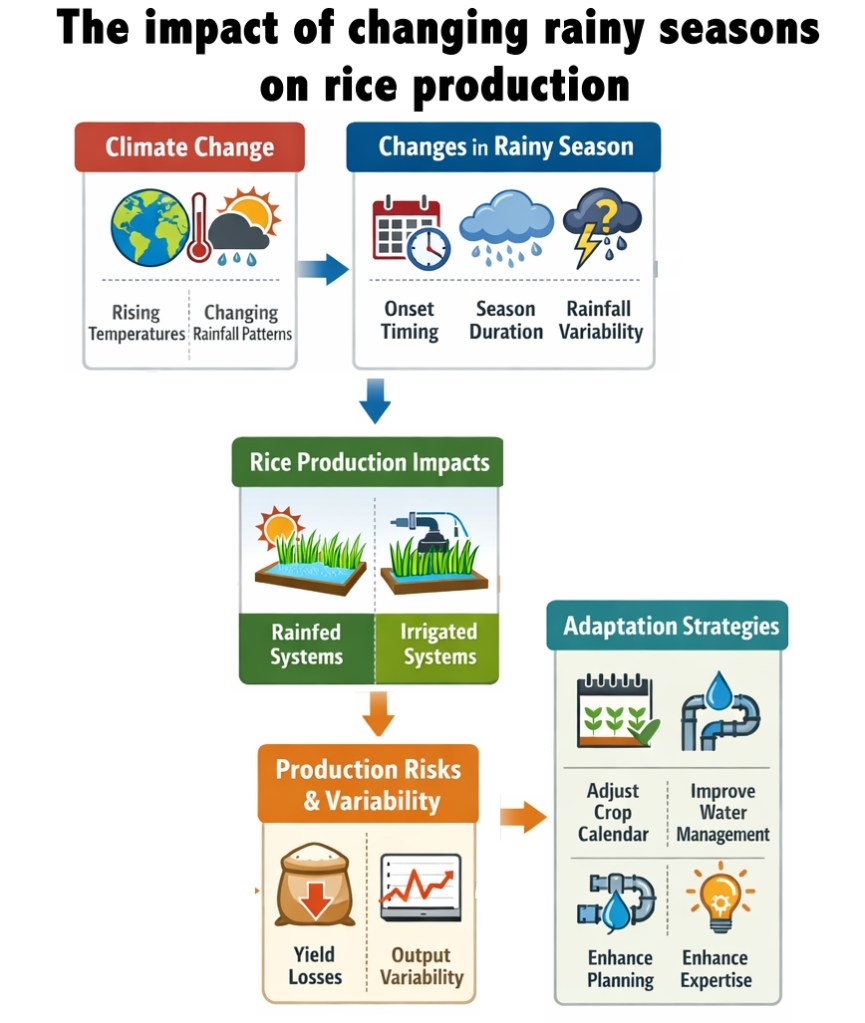
🌧️ A Changing Rainy Season
Using high-resolution climate simulations and WOFOST crop modelling, the study shows that extreme climate change is not just altering how much rain falls but when and how it falls. Across the region, rainy seasons are projected to become shorter, more variable, and delayed, with some areas experiencing up to 27 days reduction in season length. At the same time, dry seasons are becoming drier, with rainfall decreases of up to 48% in parts of Indonesia.
These shifts fundamentally disrupt agricultural production, particularly for rice systems that rely heavily on seasonal rainfall.
🌾 Impacts on Rice Production
The consequences of shifting rainy season for rice production are complex and uneven. Rainfed systems are especially vulnerable, as reduced rainfall and delayed onset directly affect planting and growth conditions. In contrast, some regions may see temporary yield increases during certain growing seasons due to increased rainfall but these gains are inconsistent and often outweighed by losses elsewhere due to decreasing the length of rainy season.
Even irrigated systems are not immune. Rising temperatures are projected to shorten growing periods, ultimately reducing yields despite irrigation support.
The study highlights a critical insight: it is not just total rainfall that matters, but the timing and duration of the rainy season. Small shifts in onset or duration can cascade into major impacts on cropping cycles, especially in regions where farmers depend on predictable monsoon patterns.
🌍 Rethinking Adaptation
Importantly, the research shows that simple adaptation solutions are not enough. For example, switching crop types alone (e.g., from C3 to C4 crops) may not sufficiently offset production losses. Instead, the study calls for more integrated strategies, including:
- Improved crop calendar planning
- Enhanced water management
- More resilient agricultural systems
- Improved planning and expertise
If you want to know more, you can read the publication here: https://doi.org/10.1007/s10584-026-04136-1



 Dr. Samuel Jonson Sutanto
Leave a comment