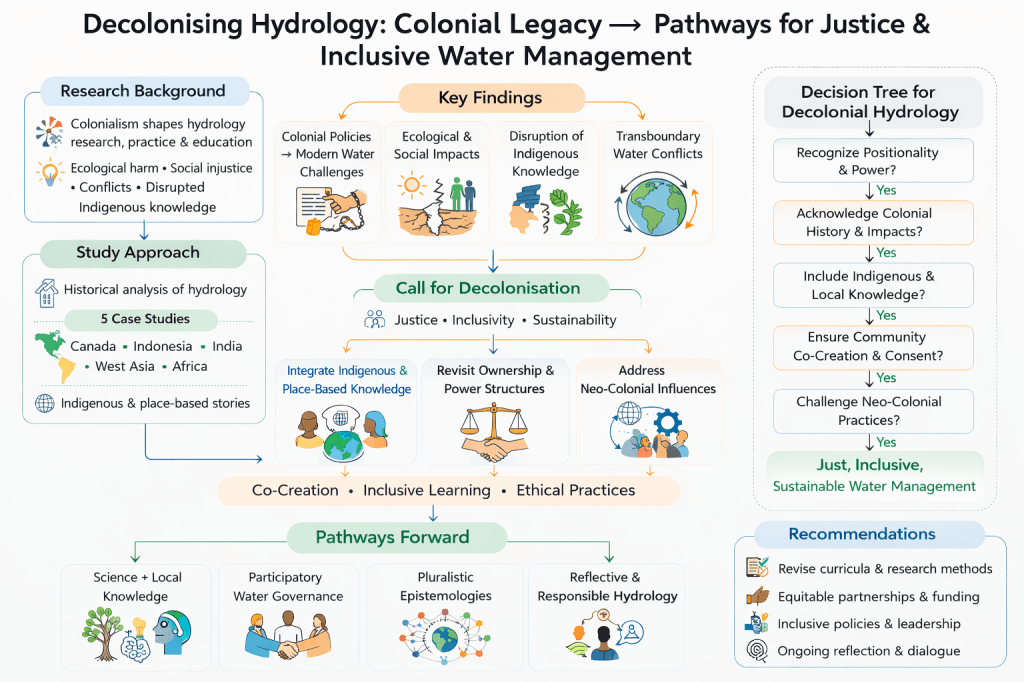
Hydrology, the science of water, is not just about rivers, rainfall, or infrastructure. It’s also deeply intertwined with history, culture, and power. In our recent paper “Decolonising hydrology: Reflecting on positionalities for sustainable and just futures”, we explore how colonial legacies continue to shape hydrological research, practice, and education across the globe, especially in the Global South.
Our paper highlights that colonial-era policies have left enduring impacts: disrupted Indigenous knowledge systems, ecological degradation, social inequalities, and even transboundary water conflicts. These challenges persist in contemporary hydrology, often hidden under the guise of technical “best practices.”
Our study calls for a transformative approach. It advocates for integrating local and Indigenous knowledge, revisiting power structures, and fostering co-created, participatory water governance. Across different scales—from individual research design to large-scale engineering projects and international scientific collaborations—reflective questions and a decision tree guide practitioners toward more just and inclusive practices.
Key pathways forward include:
- Integrating science with local and Indigenous knowledge for context-aware solutions.
- Participatory water governance that engages communities meaningfully.
- Pluralistic epistemologies to challenge Western-dominated frameworks.
- Reflective and responsible hydrology that questions assumptions, addresses biases, and promotes sustainability.
Ultimately, the findings urge hydrologists, engineers, educators, and funders to confront historical inequities and reimagine water management through justice, inclusivity, and collaboration. By reflecting on our positionalities and embracing multiple ways of knowing, the field of hydrology can move toward a future that is scientifically rigorous, socially equitable, and environmentally sustainable.
You can read more here: https://doi.org/10.1016/j.envsci.2026.104340



 Dr. Samuel Jonson Sutanto
Leave a comment