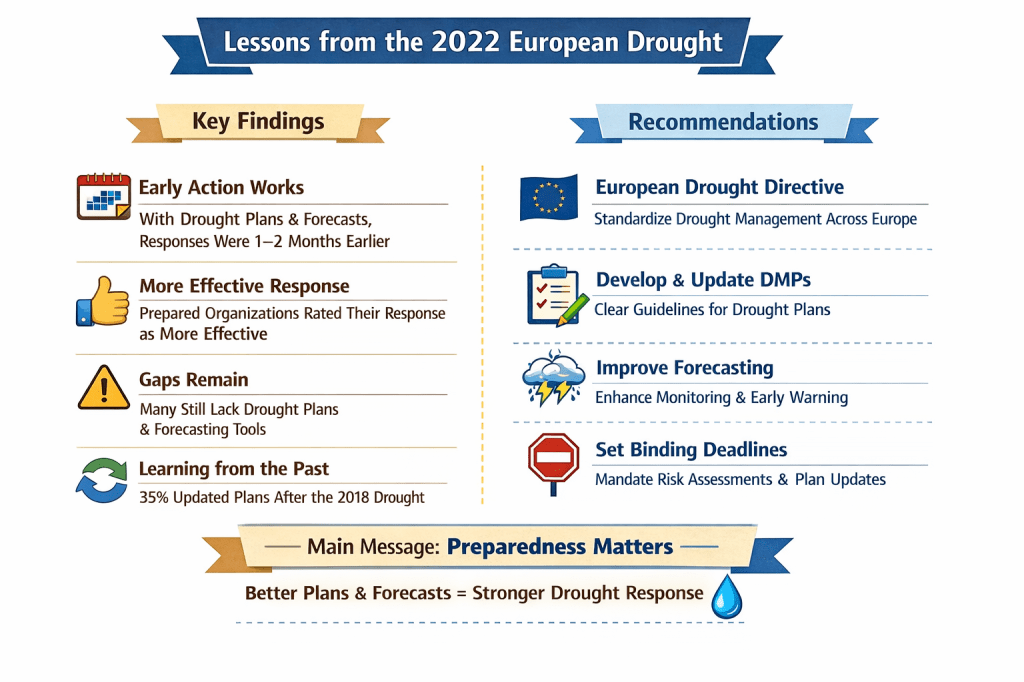
Droughts are becoming more frequent and severe across Europe, with the summer of 2022 marking one of the most extreme multi-hazard drought events on record. This new research — developed by the Drought in the Anthropocene (DitA) network, where I am involved in — examines how institutional preparedness shaped responses during this critical event. This study shows that preparedness makes a decisive difference. Based on survey responses from nearly 500 water managers, the paper finds that organisations equipped with drought forecasting systems or Drought Management Plans acted earlier—by one to two months—and rated their responses as more effective than those without such tools. Yet preparedness remains uneven, with many institutions still lacking formal plans or forecasting capabilities, and past drought impacts do not consistently translate into improved readiness. The central message is clear: strengthening drought preparedness through coordinated, harmonised governance—potentially via a European-level directive—is essential for boosting resilience to increasingly frequent and severe droughts.
📊 In short: What the Study Found
Drawing on a Europe-wide survey of nearly 500 water managers across 30 countries, combined with hydro-climatic data, the study provides unique insights into drought risk management:
- ⏱️ Preparedness matters — organisations with forecasting systems or Drought Management Plans (DMPs) implemented response measures significantly earlier than those without.
- 📈 Effectiveness is linked to planning — respondents with preparedness measures rated their responses as more effective.
- 🔄 Many organisations have updated or introduced DMPs since earlier droughts, reflecting evolving awareness and practices.
📌 What can be learned?
The paper highlights that institutional readiness — especially through forecasting and planning — can meaningfully improve drought responses. It also highlights the need for coordinated, continent-wide risk management strategies, including a potential European Drought Directive to harmonise efforts across countries.
We, therefore, recommend establishing a European-level, standardised approach to drought risk governance, ideally through a European Drought Directive that harmonises preparedness and response across countries. Such a directive should set clear guidelines for developing and updating Drought Management Plans, define institutional responsibilities, require regular drought risk assessments, support improved forecasting and monitoring systems, and introduce binding deadlines to ensure consistent, proactive drought preparedness throughout Europe.
The paper is published in Natural Hazards and Earth System Sciences titled “Lessons learned in institutional preparedness and response during the 2022 European drought.” Read the full paper (NHESS).




 Dr. Samuel Jonson Sutanto
Leave a comment