
In the summer of 2022, Europe experienced one of its most severe droughts in recent history. Long dry spells began during winter and spring, snow‐pack and water reserves decreased, heat and evaporation soared, and impacts rippled through agriculture, water supply, ecosystems, energy and beyond. The paper by Biella et al. (2025) puts this event under the microscope and asks: Can this be a turning point for how Europe manages drought risk?
Why this study is important and what are the key messages from this study?
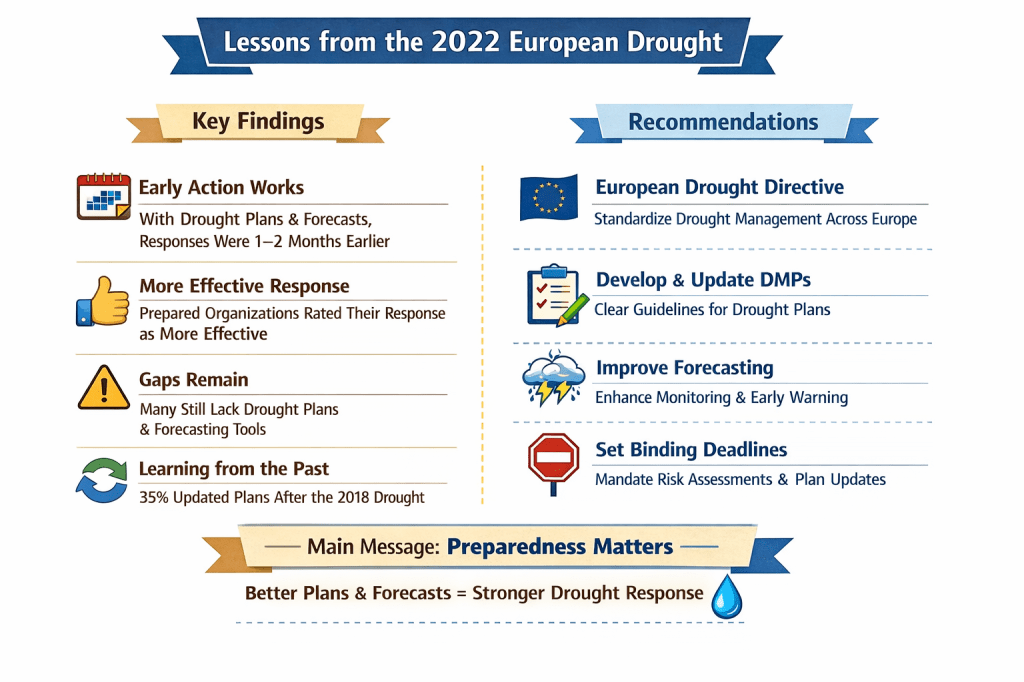
Drought risk is rising — Both the hazard (i.e., the physical drought conditions) and the perception of risk among water managers strongly point in the same direction. Most (87 %) of survey respondents believe drought risk is increasing.
The 2022 drought was exceptional — It affected large parts of Europe, started early in many places (winter/spring), and in many regions the drought persisted longer than usual.
Regional disparities in impact and capacity — Southern and Central Europe suffered earlier onset, longer duration, and higher severity of impacts (agriculture, water supply, ecosystems) compared to more northern regions. Similarly, management capacities vary widely across countries.
Management is still largely reactive — Many organisations focused on crisis response rather than proactive, systemic risk management. There are gaps in preparedness, coordination, governance frameworks, especially for drought as a hazard (compared to floods where Europe has more formal mechanisms).
Opportunity for change — The 2022 event can serve as a turning point: the authors argue for a legally binding, Europe‐wide drought directive (analogous to the EU Floods Directive) to harmonise drought risk management, enforce longer‐term strategies, and integrate systemic approaches.
What can we propose from this lesson learn?
- Move toward systemic, long-term thinking rather than short-term reactive fixes.
- Embrace integrated drought risk management, covering hazard, exposure, vulnerability, adaptations across sectors and scales.
- Harmonise governance frameworks across Europe: e.g., a European Drought Directive to set minimum standards, help cross‐border coordination, clarify roles and responsibilities.
- Improve preparedness and early warning: organisations with drought‐monitoring systems and plans fared better.
- Shift from supply-side infrastructure (adding reservoirs, etc) toward demand reduction, efficiency, ecosystem‐based adaptation.
- Foster learning from events: treat 2022 not just as a crisis but a trigger for institutional change.
To conclude, the study calls for a fundamental shift toward proactive, integrated, and long-term drought risk management across Europe. Establishing a coordinated European drought policy—comparable to the EU Floods Directive—could strengthen preparedness, improve governance, and reduce future drought impacts. The 2022 event should therefore serve as a critical turning point for building a more drought-resilient Europe.
Read more: https://nhess.copernicus.org/articles/25/4475/2025/



 Dr. Samuel Jonson Sutanto
Leave a comment