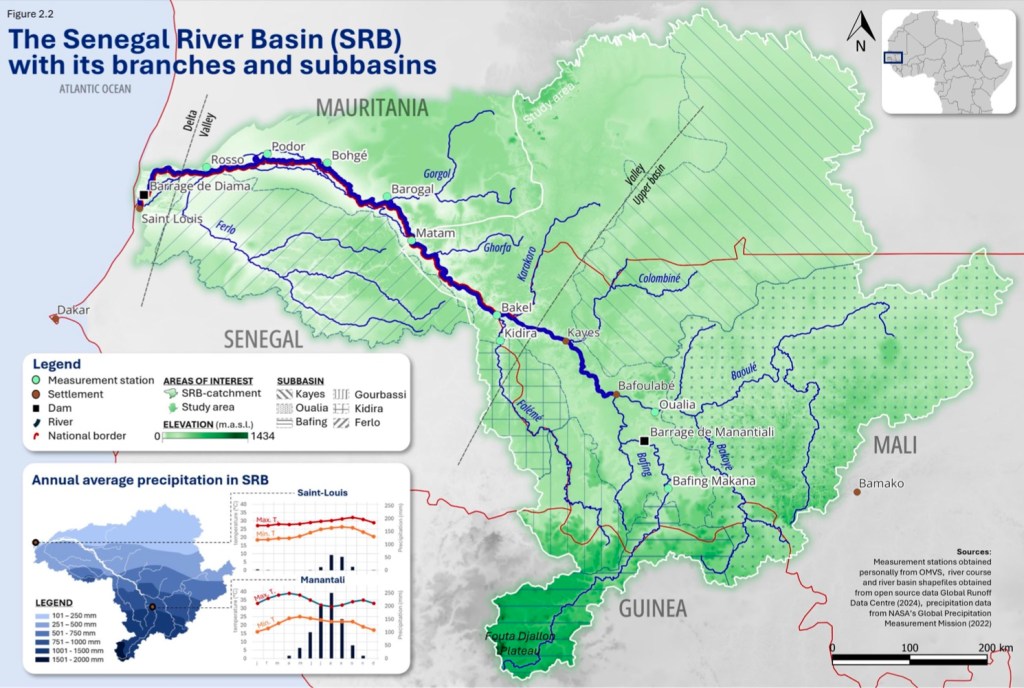
Bart thesis with the title: Integrating remote sensing and machine learning for hydrological discharge predictions in data-limited areas has been made into a short video in Youtube. In this video, Bart explained his thesis in 3 minutes. Good video and animation Bart. You can watch the video here. Below, I provide his thesis abstract.
This research aims to predict river discharge in the data-scarce Senegal River Basin (SRB) using remote sensing (RS) data integrated with machine learning (ML) algorithms, e.g., SVM-SVR and XGBoost. The baseline ML models were trained using observed data with and without CNN-based feature extraction. Moreover, the SVM-SVR and XGBoost algorithms were tested over many different input combinations using MODIS NDVI, LST, GPM precipitation, and topography characteristics. While inclusion of past data greatly improved the accuracy of the simulated discharges, with optimal lengths of 7 days for SVM-SVR (R2 = 0.82) and 14 days for XGBoost (R2 = 0.81), CNN feature extraction improved accuracy even further. The best performed model was found to be the CNN-enhanced XGBoost using NDVI, precipitation, and a flow accumulation map as inputs, achieving R2 = 0.94. With separate spatial patterns reflecting the north-south climate gradient of the basin, saliency analysis identified NDVI as the most important predictor. This study demonstrates that RS-ML integration can generate dependable hydrological predictions with limited ground data, which could be applied for flood forecasting applications, reservoir operations, and agricultural planning in data-scarce areas. Furthermore, the use of RS-ML approach is more efficient and reduces data requirements compared to physically-based models.




 Dr. Samuel Jonson Sutanto
Leave a comment